
Why walking advocates don’t agree with the 'National Walk to School Safely' messaging
A joint media release by WalkSydney, 30Please and Safe Streets to School On 20th May it is National Walk Safely to School Day. Parents are encouraged to walk with their children to school. Walking to school is normal in many other rich countries...

A joint media release by WalkSydney, 30Please and Safe Streets to School
On 20th May it is National Walk Safely to School Day. Parents are encouraged to walk with their children to school.
Walking to school is normal in many other rich countries around the world. There is no special event once a year to promote walking to school.
In Japan, a striking 98% of children walk or ride to school. The Netflix show “Old enough” is an interesting watch to see how local streets can be made safe for children. Parents send their two-year old children to run errands. The narrator seems to be more worried about the toddlers forgetting something from the shopping list rather than being hit by cars.
Also in many northern European countries the majority of children walk to school from a young age.
Not only is walking normal in these countries, children are also walking unsupervised from an early age, often from 6 years old.
Enabling independent walking to school is not only saving parents time it is also correlated with better physical and mental health outcomes for children.
On National Walk Safely to School day parents are reminded “To help children develop vital road crossing skills and ensure children up to the age of 10 years hold an adult's hand when crossing the road”.
What do other countries do so that children can walk to school unsupervised without having deadly encounters with cars?
Instead of telling parents to hold hands, some important measures include 30km/h speed limits on local streets where drivers must watch out for children and be ready to brake. Streets with higher speed limits have footpaths and crossing.
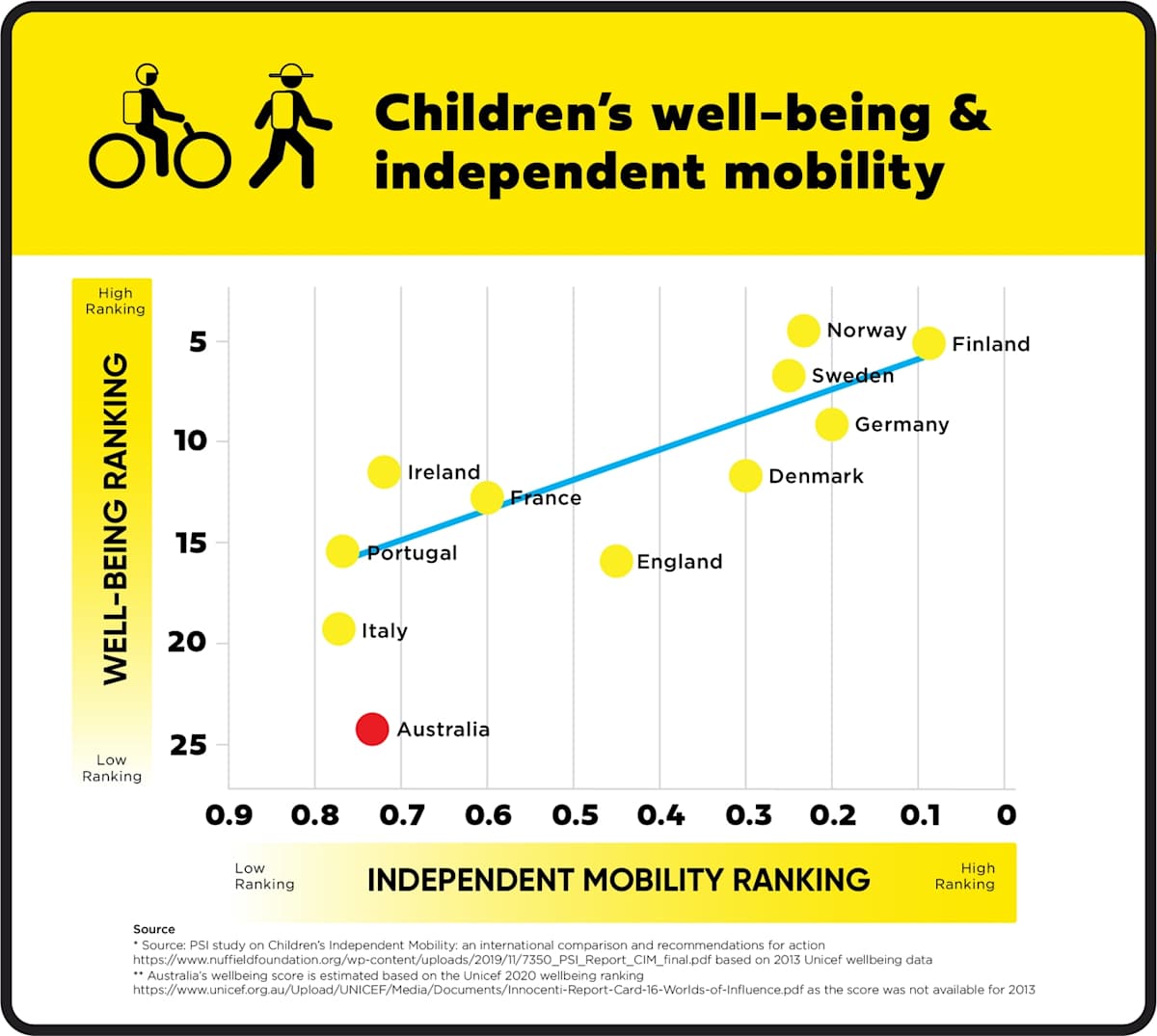
Not a single child was killed on the roads of two Scandinavian capital cities, Oslo and Helsinki, in 2019. This is even more impressive as Norway and Finland score among the highest of all rich countries with regards to children’s independent mobility (and children’s mental and physical wellbeing).
According to the NSW Centre for Road Safety, in a crash between a car and somebody walking, there is a less than 10 per cent risk that the person will be killed at 30 km/h, 40 per cent risk at 40 km/h, and a 90 per cent risk at 50 km/h.
Prof David Levison, Founding president of WalkSydney said: “According to Austroads the most effective way to improve pedestrian safety is lower urban speed limits. We should focus on the real underlying issue – cars that are driving too fast and streets are too hard to cross. Every day should be walk-to-school day, and children should be able to travel independently.”
Jon Lindley, co-founder of Safe Streets to School Australia said: “All kids and families should be able to enjoy getting to school safely. Many streets are too hard to cross for children and many streets lack footpaths.”
“Four decades ago, 3 out of 4 children walked or cycled to school, compared to only 1 out of 4 children today. Since the 1970s the number of cars has increased by a factor 4 on Australian streets and not much has been done to reduce the negative consequences this has on our children who need to navigate traffic when walking to school. Consequently, government sponsors special events like the Walk to School Day. But if we don’t make our streets safer for walking, there is little hope we will get any traction from it.”
“Our vision is one where children can walk to school independently without having to worry to be hit by fast-moving cars. We are campaigning for footpaths and crossings or 30km/h speed limits within the walking catchment of schools”
Lena Huda, founder of 30please.org said: “At National Walk Safely to School day, parents are told to hold children’s hand up to the age of 10 years old. This is not good enough to get our children to school active and safely.”
“30km/h speed limit in local streets are the global best practice to keep people safe in neighbourhoods. They create a better balance between the needs of drivers and children. School children should be able to walk to school with their friends rather than needing constant supervision by their parents.”
Researcher from the University of Newcastle and author of a recent article “5 myths about 30km/h speed limits in Australia” Matthew Mclaughlin said, “When road safety relies on school kids holding adult hands, we know it’s gone seriously wrong.”
Explaining he said “People make, and will always make, mistakes. But streets with 30km/h speed limits are forgiving to inevitable mistakes – ultimately leading to less life-changing injuries and deaths.”
“Streets with lower speed limits benefit our physical and mental health, lead to less exhaust emissions and are more liveable – attracting higher house prices. By contrast, ‘hold hands’ messaging leads to none of these benefits” he added.
FOR MORE INFORMATION
WalkSydney is the peak body for walking in Greater Sydney. Walksydney.org
30please is campaigning for a 30km/h default urban speed limit. www.30please.org
Safe Streets to School is a community campaign to create safer streets within the walking catchment of schools in Australia. www.safe-streets-to-school.org


