
BlueFloat bails, 'headwinds' hold up offshore renewables
What's the forecast now for the Illawarra Offshore Wind Zone?


Offshore wind has been a gift for headline writers, who love a nautical pun, The Illawarra Flame as much as anyone. So when long-anticipated news blew in that BlueFloat – the only company dangling on the government’s hook in the Illawarra Offshore Wind Zone – had formally withdrawn due to global forces, the only real question was: is it facing “headwinds” or has it “sunk”?
“For me, it's headwinds because I look at the inevitability of the need for us to decarbonise,” said Energy Futures Network director Ty Christopher at the University of Wollongong.
“The fact is the need for offshore wind still exists today. We still need multi-gigawatt scale, high-capacity factor, highly available generation that doesn't involve construction of hundreds and hundreds of kilometres of major transmission lines to get it from where the generation occurs to where it's going to be used, which is right along the coast. Those three needs that were there, and were the why of offshore wind, are still there today.
“If global capital turns around and another applicant emerges, this could be a 12-month delay; I think that's probably the most optimistic time-frame. Realistically, it’s probably more in the one to five-year range.”
MPs say setback 'not the end'
BlueFloat’s exit was described as “a setback" but “not the end” in January’s joint statement from Cunningham MP Alison Byrnes, Gilmore MP Fiona Phillips and Whitlam MP Carol Berry. The three federal members for the Illawarra are from the Labor Party, which dominates at all levels of government in the steel city of Wollongong after the “red wave” at last year's election swept away Peter Dutton’s vision for a nuclear future.
Responses to BlueFloat’s exit from across the political spectrum – even the howling gale of opposition on social media – also point to “headwinds”. Neither the anti- nor the pro-wind groups will drop their campaigns despite the zone having zero applicants.
Unruffled, Good for the Gong insists the Illawarra remains “an attractive place to invest” for renewables developers, while Responsible Future Illawarra sees fresh dangers swirling in “a future relisting” and is calling for the zone’s closure.
Ultimately, Ty Christopher, an electrical engineer who spent almost four decades in industry before taking on an energy leadership role at UOW, acknowledged the news was “obviously a disappointment”.
“It is, at best, a delay to our journey of decarbonising in particular our heavy industry and our major commercial centre, the Wollongong CBD. That's not ideal for our region,” he said this week.
“That's not ideal from an employment and an economic growth perspective and it's certainly not ideal from an environmental perspective as we look at our climate.”
“On the positive side, there's the research and development licences that are out there.”

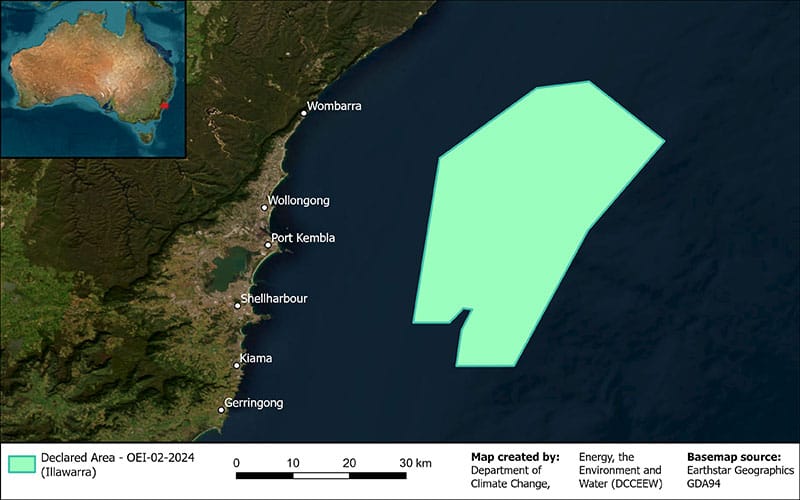
Energy Futures Network Director Ty Christopher. At right: the Illawarra zone is now in a research phase. Photos: Anthony Warry, DCCEEW
Applications for research and demonstration (R&D) licences are now open for all of Australia’s six offshore wind zones, and Ty said “multiple companies” were in line to trial not just floating offshore wind but wave- and current-based technology.
While researchers will welcome the opportunity, it means the government’s pitch – to create 1740 new jobs during construction and 870 ongoing jobs at an Illawarra wind farm – is now a soft sigh on the horizon.
Driving forces behind decision
“BlueFloat has made this decision based on commercial reasons, driven by global pressures including supply chain constraints, impacting the offshore wind industry worldwide,” the Illawarra MPs said in their statement, which was dropped at 4pm on the Friday of the Australia Day long weekend.
In entering a lull, the Illawarra zone joins the Hunter, scuppered last year by the exit of Norwegian energy giant Equinor, and the Bass Strait zone, where the government recently decided not to offer feasibility licences due to a lack of competitive bids.
In Ty’s opinion, “this is symptomatic of a global retreat of capital from offshore wind in certain locations. It started in the US.”
While markets remain “jittery” under the Trump administration, offshore wind is not universally scuttled and Ty said the UK was seeing “record levels of interest”.
A flagship event
On January 14, the UK government announced it had secured 8.4GW of offshore wind in Europe’s biggest offshore wind auction – enough clean electricity to power the equivalent of over 12 million homes.
Ty tips these projects as ones to watch, while closer to home, he said South Korea and China are streaming finances into offshore wind projects “at a record rate”, with Chinese developers recently unveiling a colossal prototype, a single 25MW turbine.
From the experts’ perspective at UOW’s Blue Energy Futures Lab, an informal collaboration by more than 30 academics, the zone’s failure to attract feasibility licences is seen as a good time to “cool the temperature” after years of polarised debate buffeting the community.
As a spokesperson for the lab, Ty hopes for “respectful discussions” about the Illawarra’s clean energy future and warns against the hypocrisy of saying “I support renewables, but just not here”. “What you're saying is 'well, somebody else should bear the burden for my benefit.’
“To anyone that says, 'Oh, well, we should put all of the wind generation resources in the middle of Australia', I say, 'Great. Can you be the person that leads the discussion with the landowners and the people out west and stands up and explains to them why they should look at transmission lines because you don't want to occasionally be able to see offshore wind.' I'll sit back with popcorn and see how that goes for you.
“The reality is you have a small community who bear the greatest degree of affectation due to their proximity [to the onshore farm] and you have a much larger community who bear little or no affectation or impact, and reap nearly all of the benefits.”
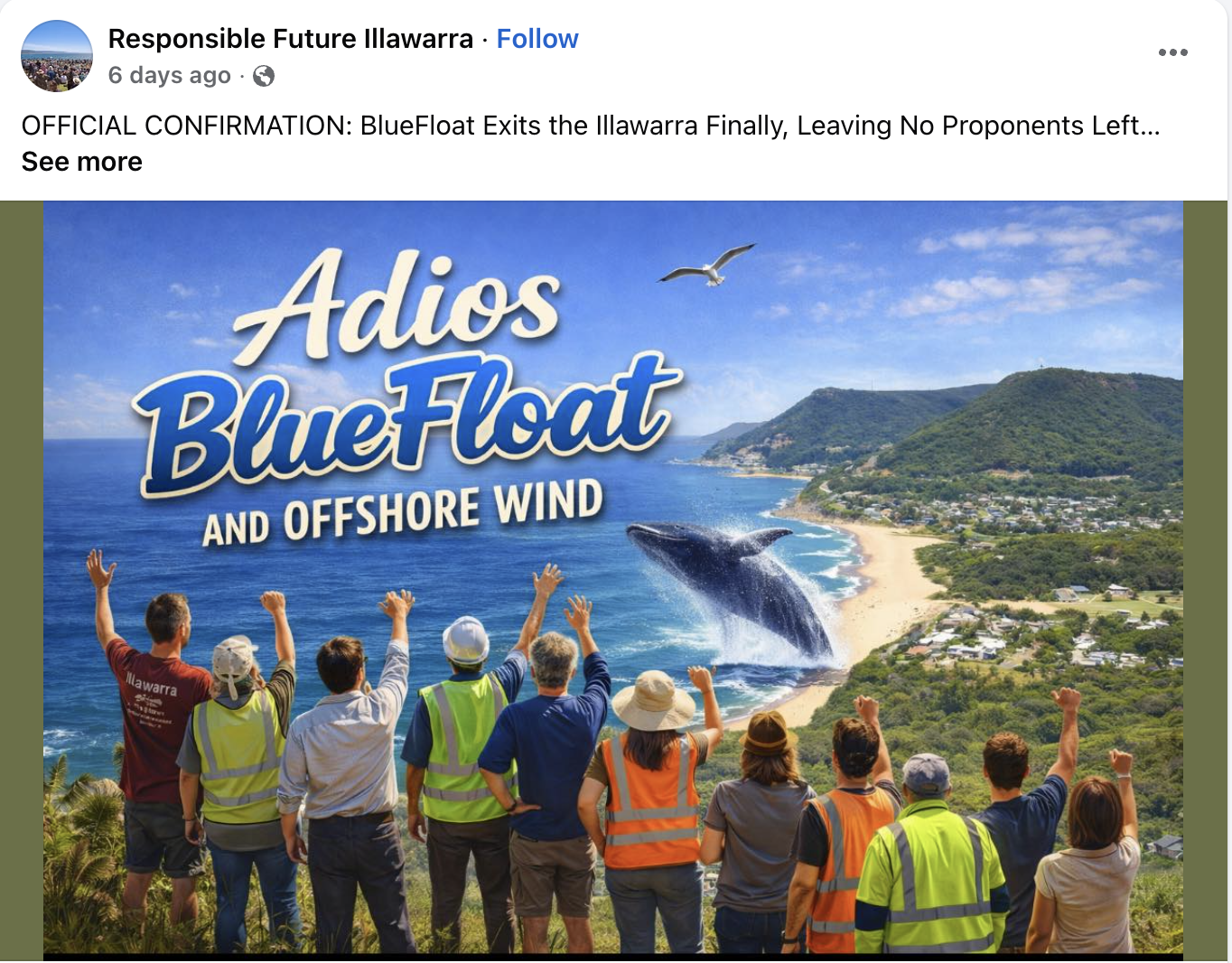
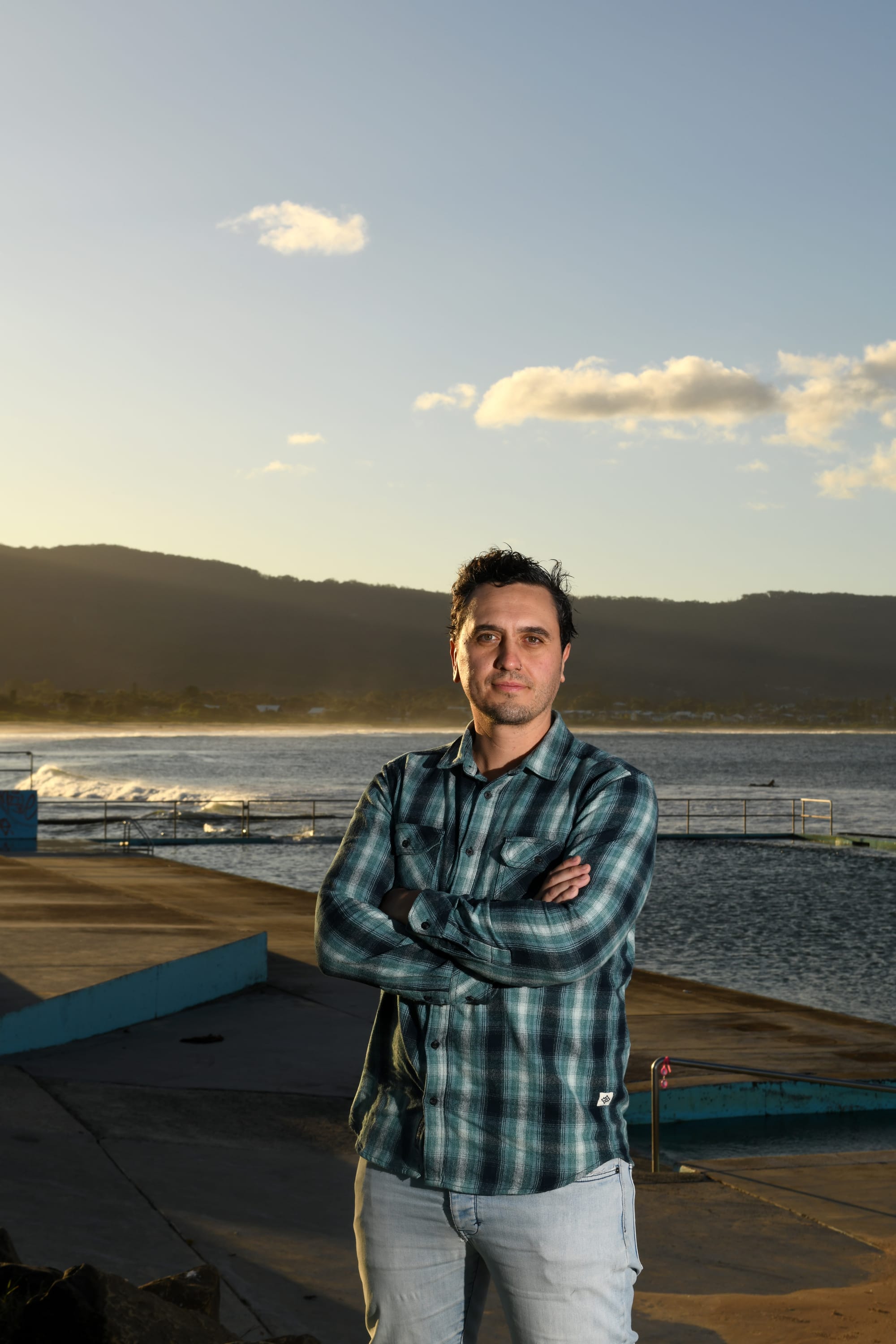
A post on RFI's Facebook page and association president Alex O'Brien. Photo: Unicorn Studios
‘Door has always been open’
Meanwhile, as well as demanding “a rethink” of the Illawarra’s decarbonisation strategy, Responsible Future Illawarra (RFI) is calling for “a constructive reset” and for MPs to engage in discussion.
“Our door has always been open, and it remains open,” said Alex O’Brien, a financial advisor who heads up the local chapter.
“We support renewables in the right locations…
“RFI will continue until the offshore zone is formally cancelled, with a broader role scrutinising future energy proposals, supporting community education and ensuring energy decision-making is transparent and accountable. Accepting reality, avoiding further waste of taxpayer dollars and reducing community division is essential.
“The Illawarra has been through a long and, at times, painful process over this proposal. While we raised concerns early, we would much rather this had been resolved transparently and collaboratively, without putting the community through so much uncertainty.”
That “painful process” began with angry public forums in October 2023 and fake news spreading on Facebook. It became politically super-charged in the lead-up to the 2025 federal election, with then-Nationals-now-One Nation representative Barnaby Joyce telling Lake Illawarra rally goers to use their votes as “bullets”, the RFI leader heckling Prime Minister Anthony Albanese at a pre-election event, and a crowd booing an Acknowledgement of Country at RFI's Warilla candidates forum, which Labor MP Alison Byrnes declined to attend due to safety concerns after online threats.
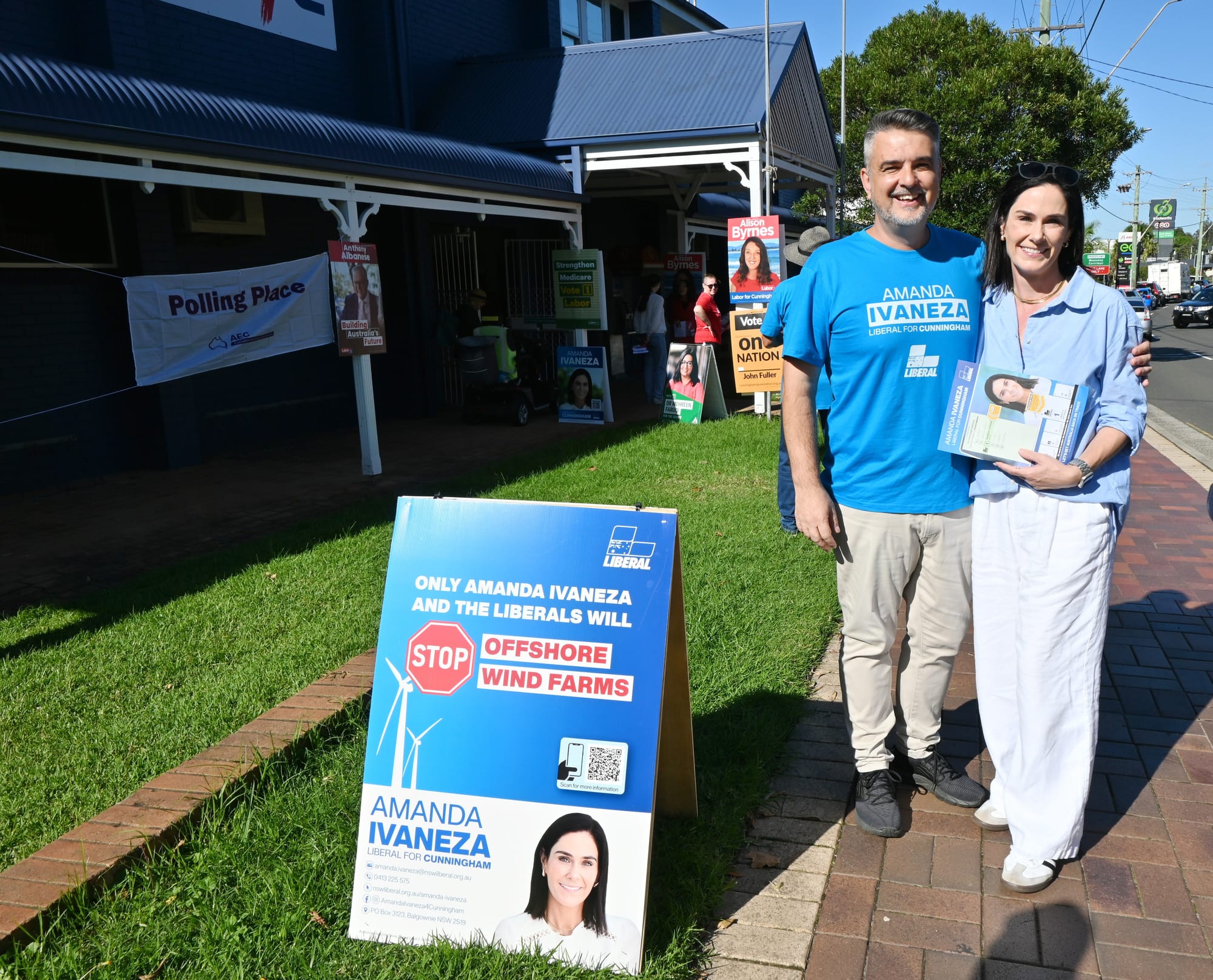
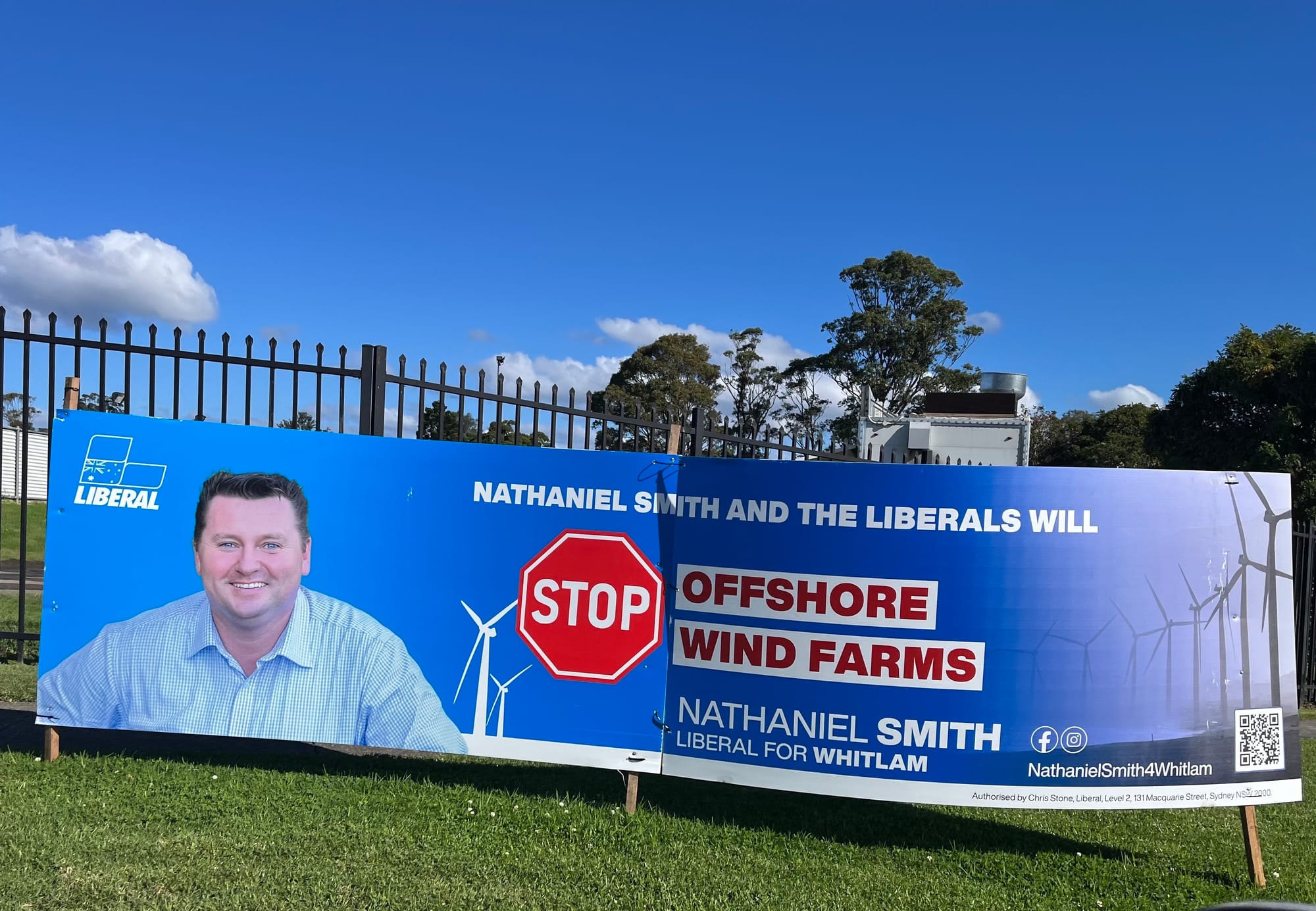
"Stop Offshore Wind Farms" was a key slogan for local Liberal candidates at the 2025 federal election. Photos: Illawarra Flame
Locally, Liberal candidates campaigned strongly on a “no offshore wind” blast in 2025 but failed to win over a majority of voters.
'Locals want a safe climate'
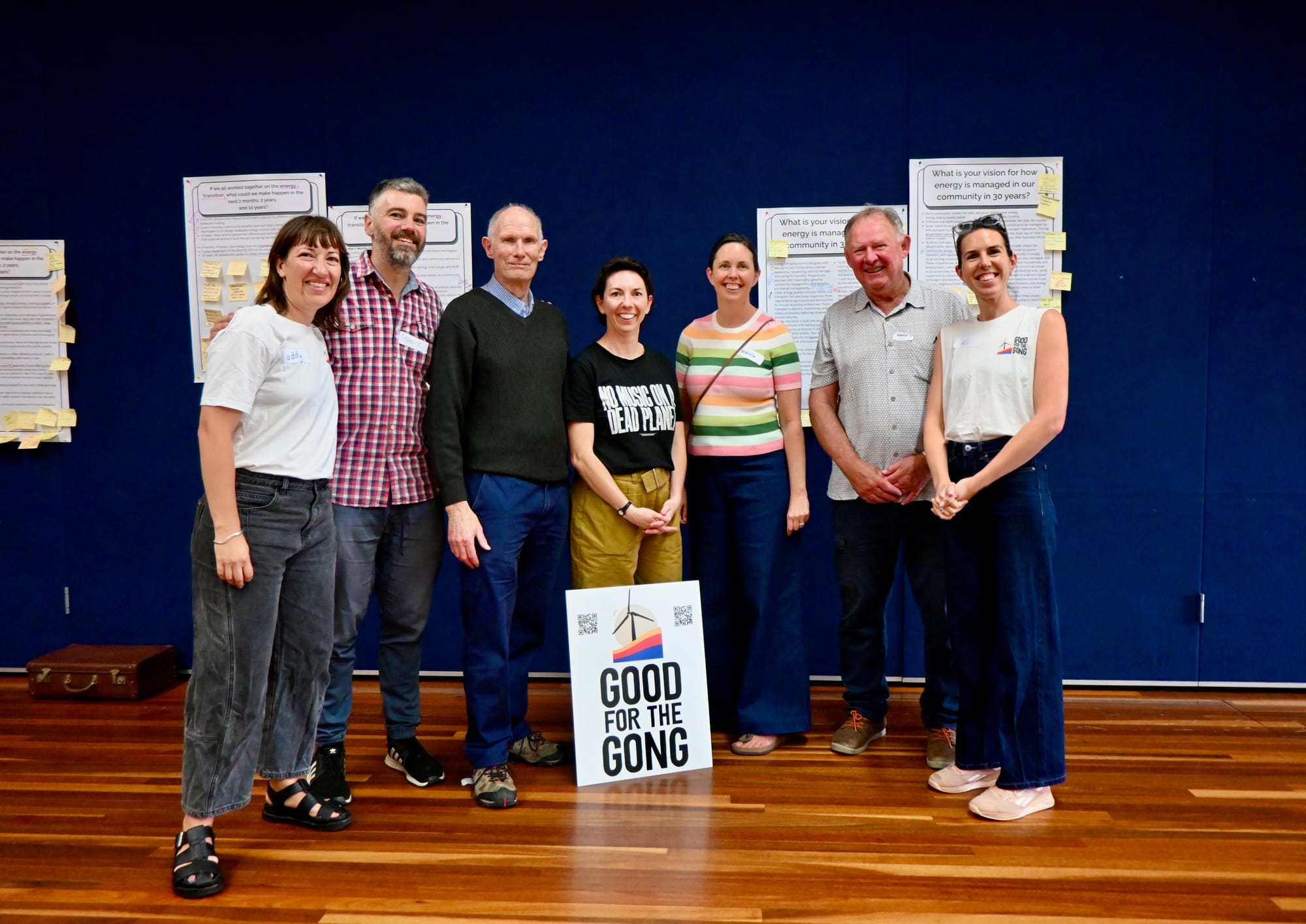
Retired coalminer Darryl Best, a board member and spokesperson for Good For The Gong, said the group’s volunteers did “many surveys and extensive door-knocking” in the region last year.
“What we found was that the majority of people in the Illawarra support the shift to clean, renewable energy. Illawarra locals want a safe climate, they want clean and reliable power, and for our region to reap the benefits of being a renewable energy powerhouse,” Darryl said.
“The group acknowledges that global financial uncertainty may affect energy projects, but says the Illawarra continues to stand out as an attractive place to invest for its industrial strengths, skilled workforce and strong community support for climate action and renewable energy.”
Ty Christopher said BlueFloat backing out had nothing to do with local resistance and everything to do with risks associated with multibillion-dollar investments.
“It's important, I think, not to have tickets on ourselves as a region and a nation and think that a bit of stomping and shouting was in any way an influential factor in the decisions that have been made by these large global companies,” he said.
“The overriding and indeed the prime decision-making factor has been global risk attacks on the industry coming out of the US.
“Just at Davos recently, Trump was still in the most Don Quixote-esque way tilting at windmills, as he calls them, and expressing his fervent dislike for the technology. I'll leave your readership to examine the amount of fossil fuel funding that went into Trump's election campaign and draw their own conclusions from that.”
Where will ‘headwinds’ take us?
“What does this, in terms of a delay to the implementation of offshore wind, mean? We don't have to guess,” Ty said.
“Just last week we heard that the Eraring coal-fired power station’s operational life will be extended by another two years.”
This means more thermal coal will be dug up in the Hunter Valley’s open-cut mines to burn at Eraring, which is owned by Origin Energy and the largest coal-fired power station in Australia. This will release “many more millions of tons of CO2 into the atmosphere to supply electricity”, Ty said.
“So it's not complicated to see what the ramifications of delay in the clean energy journey are.
“And the question that I'd ask of people is: is that a particularly responsible future for us to be facing?”


