
When to draw the line
A tale of global cataclysm, mass extinction and destiny hidden beneath the Sea Cliff Bridge, by Nathan J. Enriquez, a local PhD palaeontology student with a passion for all things prehistoric

A tale of global cataclysm, mass extinction and destiny hidden beneath
the Sea Cliff Bridge, by Nathan J. Enriquez, a local PhD palaeontology student with a passion for all things prehistoric
It is 252 million years ago. All the world’s continents are combined into a single landmass, surrounded by a single, vast ocean. Dinosaurs are yet to evolve. In fact, reptiles at this time are relative newcomers, and plant life on what would become today’s southern continents is dominated by a now-extinct type of tree called Glossopteris, whose abundance across the Australian landscape rivalled even that of today’s eucalyptus trees.
This is the setting for arguably the most tumultuous event in the history of life on Earth: the Permian-Triassic Mass Extinction, also known as ‘The Great Dying’, which wiped out perhaps more than 90% of species on the planet at the time and is the largest of the five historical mass extinctions.
Today, this event is recorded beautifully on our own doorstep, in the rocks that lie below the Sea Cliff Bridge between Coalcliff and Clifton. These provide a tantalising window to a time when life itself was nearly extinguished.
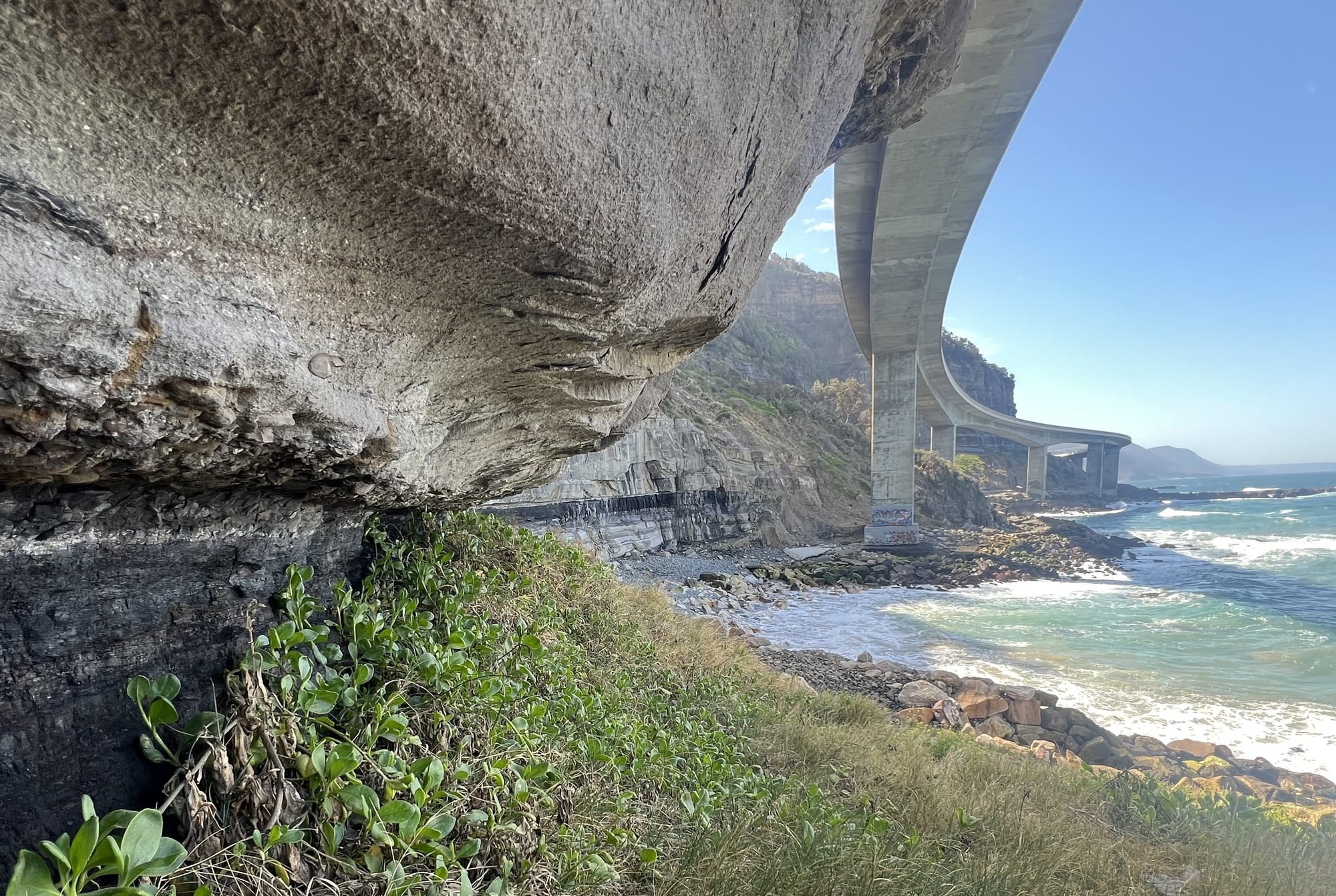
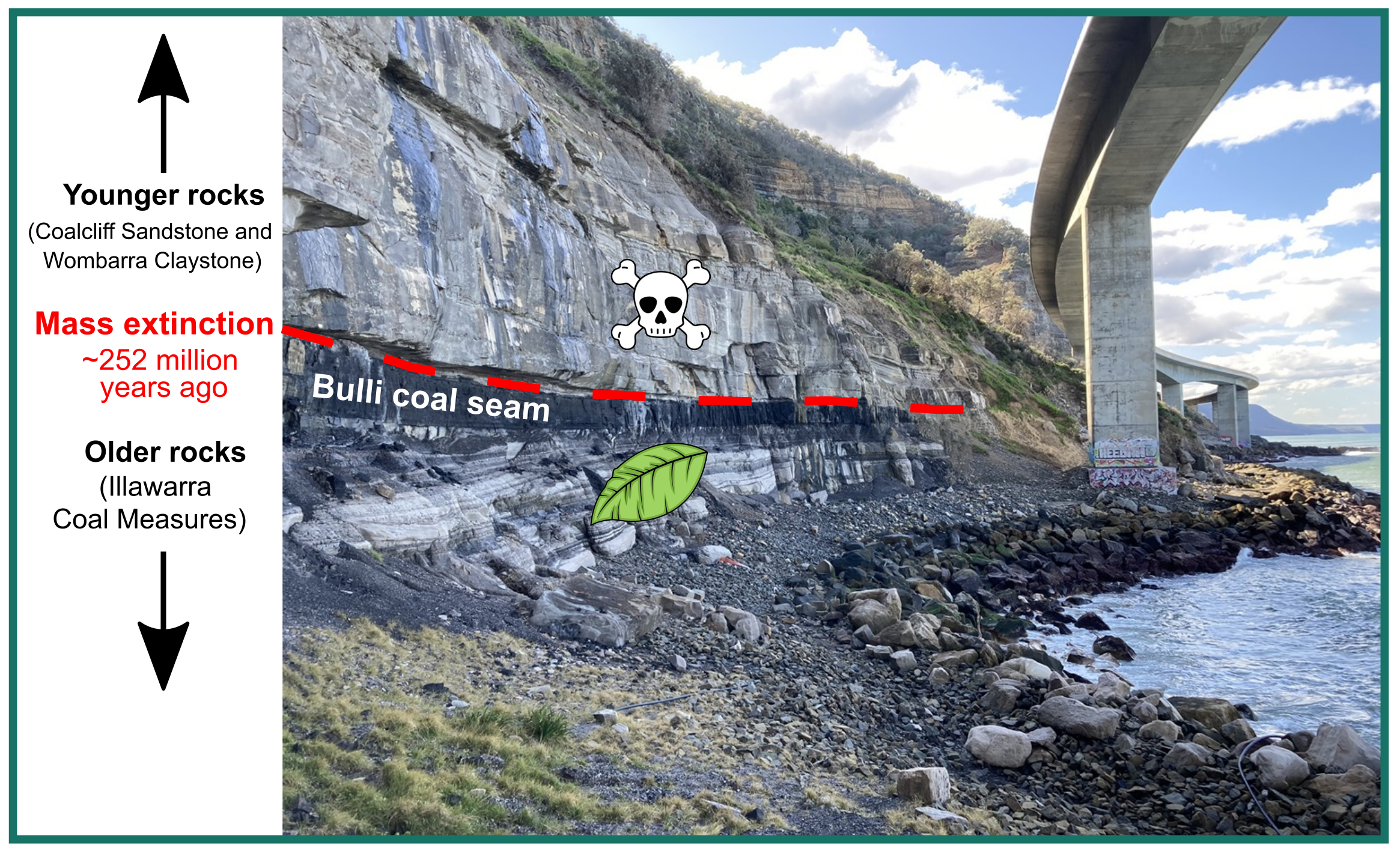
If you look closely at the cliff face next to the Sea Cliff Bridge, you will notice many different horizontal layers of rock stacked on top of one another. Each of these are made up of sediments that were deposited within ancient rivers and lakes in successive order, so that the oldest are on the bottom and the youngest are on the top.
Specifically, the base of the cliff section underneath the bridge is part of the Illawarra Coal Measures and records some of the final years of the Permian period. As the name suggests, dark coal layers are abundant here and represent the compacted and preserved remains of prehistoric plants. If you could travel back to Coalcliff at this time, you would have seen a vast swampy ecosystem dominated by Glossopteris trees. But in a geological blink of an eye, disaster struck, and the landscape was stripped bare. This change can be seen in the cliff underneath the southern end of the bridge. The final layer of Permian coal – the Bulli coal seam – is approximately one and a half metres thick in the cliff at this location.
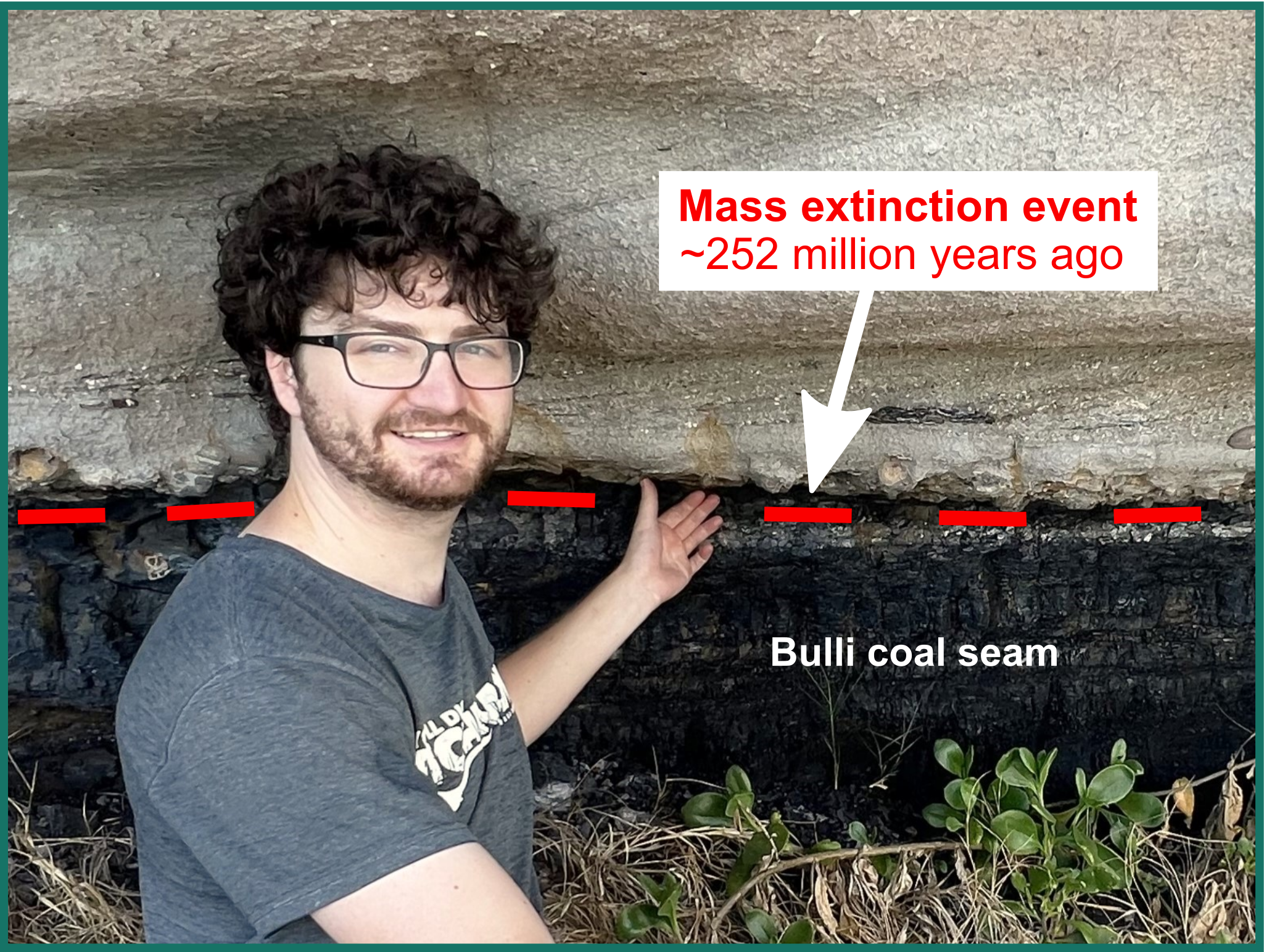
At the top of the seam, there is an abrupt transition to sandy, pale-coloured layers. Evidently, the vegetation that had been forming the coal here suddenly vanished. Although not overly remarkable on its own, similar disappearances are observable at geological sites close to the same age all around the world and collectively mark the moments in time when almost all species had disappeared. But why?
Unlike the meteorite impact that famously ended the age of dinosaurs 66 million years ago, the primary cause of the Great Dying is thought to be volcanic activity, as huge eruptions in Siberia at about the same time released millions of cubic kilometres of basalt lavas like those that currently erupt on Hawaii. Accompanying this enormous quantity of lava were extremely high levels of carbon dioxide and sulphur dioxide, which were released into the atmosphere and oceans, causing a greenhouse crisis that made temperatures soar around the planet, poisoned the ocean by depleting seawater oxygen levels and also turned it highly acidic.
Under these conditions, marine life was hit particularly hard and suffered the highest extinction rates. The trilobites – those crustacean-like marine invertebrates that have become the quintessential depiction of early life on planet Earth – did not survive this event. In the Sydney area, the great forests of Glossopteris trees were wiped out at nearly the same time, as seen by the abrupt end to the Bulli coal seam under the Sea Cliff Bridge.
The official boundary marking the end of the Permian period and the beginning of a new period in Earth history – the Triassic – occurs at a level within the cliff somewhere above the Bulli coal seam. Determining exactly where is difficult, as the mass extinction was prolonged over hundreds of thousands of years and hit different parts of the world at slightly different times. In any case, by the time the extinctions slowed at the dawn of the Triassic, the Sydney area was barren and devoid of forests. This can be seen by the endless masses of sandstone that dominate the upper parts of the cliff above the level of the road: there were no more swampy forests, only sand. It would take millions of years for the less than 10% of species that survived the extinction to re-populate the earth and diversify. All species living on the Earth today – including us – are descended from this small collection of survivors.
The next chapter in Earth history after the extinction was a dramatic one.
The beginning of the Triassic period also meant the beginning of the Mesozoic era, otherwise known as the age of dinosaurs. Although the rocks near the top of the cliff that tower over the Sea Cliff Bridge are approximately 15 million years too old to contain dinosaur fossils (a mere blink in geological history), they represent a time when many of the ecological roles that were previously occupied in the Permian period were now up for grabs, as the extinction had cleared away many different types of animals and effectively eliminated much of the competition. This led to the evolution of new reptile lineages, eventually including the first dinosaurs, which appeared roughly 235 million years ago.
So the next time you are crossing the Sea Cliff Bridge, spare a thought not only for the devastation and near-total annihilation of life on Earth that is recorded in the rocks below you, but also for the great reptilian empire that was destined to come.
If we’re not careful, the planet may be headed down a similar destructive path today, as rapid climate change spurred on by human-induced greenhouse gas emissions is eerily comparable to what happened 252 million years ago. Let’s all hope that this is where the similarities end!