
Bat-ter late than never: it's time to celebrate our night-flyers
Between pest control and pollinating our region’s forests, some of our wee winged beasties deserve credit

Bats have had a rough time this year. Large numbers of grey-headed and black flying foxes perished in an extreme heat event, relentless rain washed away vital food sources and many others starved or were taken into care.
It’s all been a bit depressing, but I had an unexpected reminder of nature's resilience and the impact we can have drop – quite literally and just in time for International Bat Appreciation Day – into my backyard.
The Illawarra has around 20 species of bats including several recent additions which probably moved to the region after climate change affected their usual home territory.
Unlike the larger flying foxes, which can’t be missed – hanging upside down in large colonies chattering away and arguing – microbats are much more secretive. You might find them nuzzled up under your garden umbrella or in a dark corner of your shed due to a lack of places to roost in the urban environment, but they much prefer tree hollows or as I discovered, roosting under tree bark.
The secret in our gum tree
Our gum tree hosts an abundance of life. Jumping spiders weave silken nests in the divets of the trunk while birds and possums drop by to feast on the leaves or unsuspecting moths and cicadas.
As the trunk starts to crack open, large thickened pieces of bark can be pulled away, providing the perfect spot to ferret yourself away, if you are, for example, a microbat.
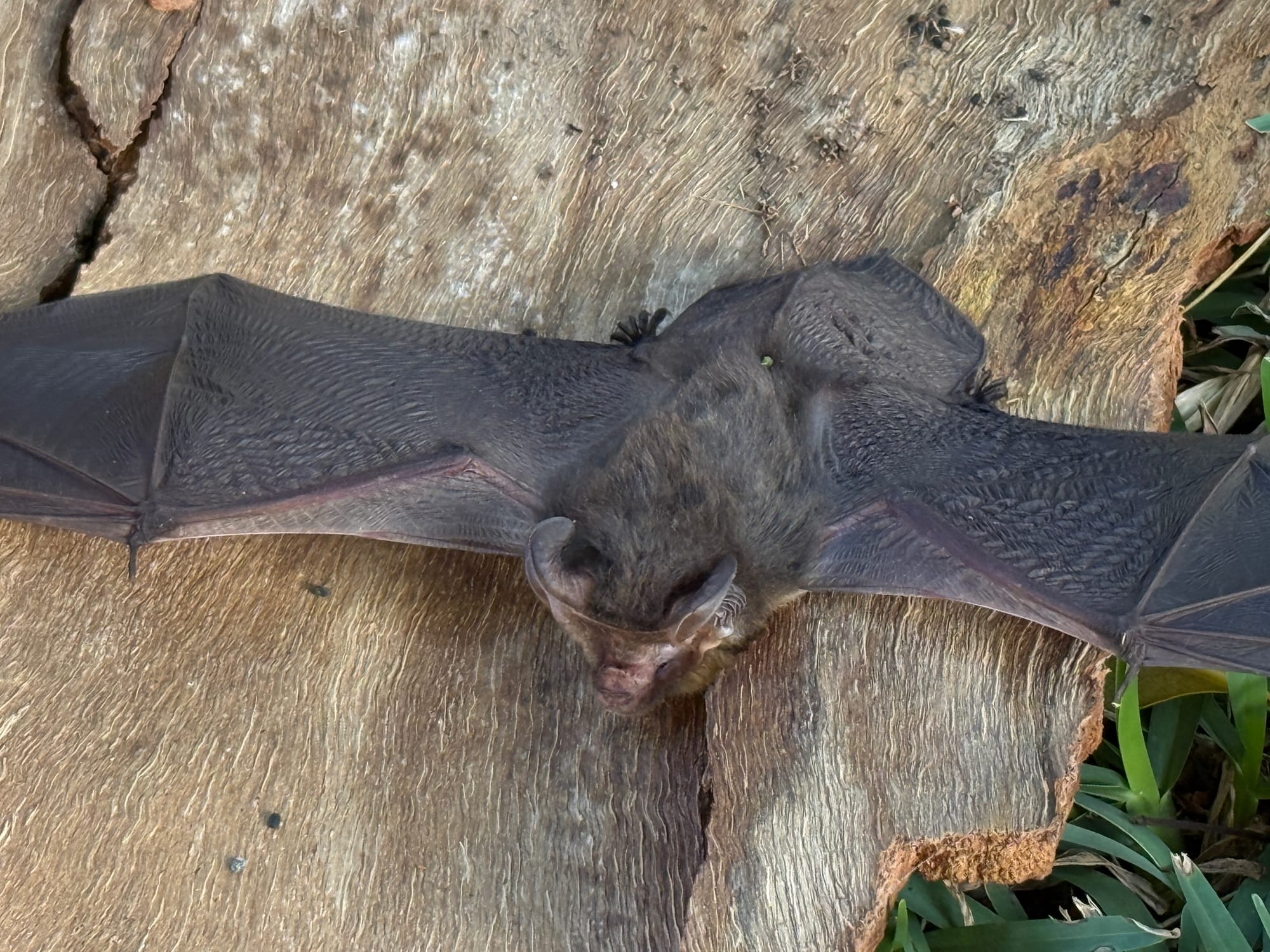
I’ve always wondered where the tiny bats that flit around our yard roosted but it wasn’t until one of those huge pieces of bark came crashing down, interrupting our Friday evening glass of vino on the deck that I had my answer. Holding on very tightly, wings stretched wide, its tiny body trembling after a very rude awakening, was a lovely little Gould’s long-eared bat (Nyctophilus gouldi).
Appreciating our unsung batty heroes
Eater of mozzies and assorted creepy-crawlies – microbats can eat thousands of prey items a night – they provide the perfect natural backyard pest control. It was the first time I had ever spotted this species, and you have to admit, as far as things that can crash-land in your yard, it’s got to be one of the cutest.
After it was clear that the bat was unhurt, I gently tilted its bark bed up on an angle and the bat took to the sky, circling the yard twice before heading to the top of the trunk and crawling under another area of bark.
Between the larger flying foxes and the smaller microbats, two vital ecological functions are covered: pest control and pollinating our region’s forests. I reckon that deserves a bit of appreciation.
How to help our bats
International Bat Appreciation Day is April 17.
To help our local bats, consider planting a vast diversity of plant species, especially flowering gums, keeping old trees with hollows and bark and not using pesticides.
Less than one per cent of bats carry Australian bat lyssavirus, which is fatal to humans and transmitted by a bite or scratch from an infected bat. Just remember – no touch, no risk – and contact WIRES if you find a sick or injured bat.