

Council's action on renewables gets thumbs up from Knitting Nannas
The Illawarra Knitting Nannas Against Greed cheered the result of an energy transition debate at Wollongong City Council's June meeting

If the irrepressible Knitting Nannas Against Greed give their seal of approval to something, it generally means it’s good for the city, region, nation and planet.
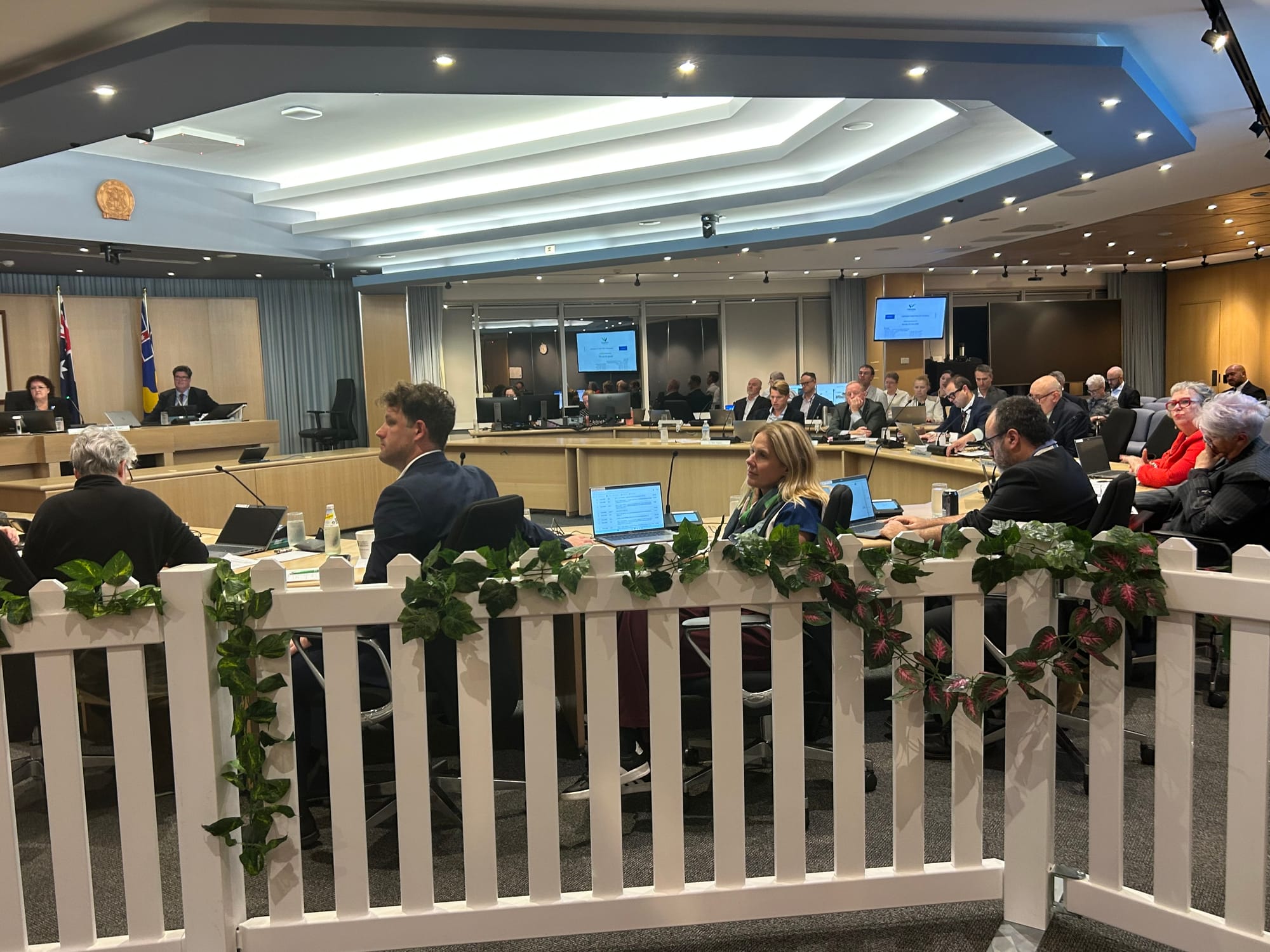
So it was at June 29's Wollongong City Council meeting, when councillors debated whether or not the organisation should stop funding a commitment to new renewable energy infrastructure until a long list of checks and balances was met.
It started as a notice of motion from Ward 1 Liberal Councillor Ryan Morris, who expressed his concern that Council may be inadvertently signing contracts for products which could be taking advantage of child labour or other exploitative labour.
Cr Morris questioned if, in trying to achieve its goal of net zero emissions by 2030, Council may not be “acting with ethical and moral leadership in the renewable energy infrastructure landscape”.
“Cr Docker spoke before about people in this building who are underpaid because of their disabilities. Why are we only thinking about people in this building, if we were buying items from countries overseas that are underpaying their people? Should we be aware of that as well?”
Cr Morris’s motion, if passed, would require a written guarantee that no component of a product, material or system involved child labour of any other form of exploitation.
'Trying to protect us'
"The energy transition is massively coming out of third world countries," Cr Morris said. "This is about trying to protect us. We need to have something to protect ourselves and protect our residents going into the future.”
Council needed a “more robust” policy in striving to reach 100% renewable, he said.
“Are we going to live with our heads in the sand? We’re now accepting that our children’s future is going to be better off the backs of children in other countries who are being sent down mines to mine. Sixteen percent of those mines are child labour.”
Ward 2 Labor Cr David Brown expressed his suspicion at the motivation for the debate.
“I’m looking at the motion and I’m having trouble seeing it as anything other than a bit of a stalking horse against renewable energy. Why do we only choose renewable energy as the only possible place to look at for antisocial procurement practice and not everything else we do.”
Cr Brown said it should be the state and federal governments that “do the heavy lifting”.
Concern over 'poison pill motion'
“I’m worried that it looks like a bit of a poison pill motion," Cr Brown said. "We were asked to say bad things about renewable energy which I don’t want to do.”
Ward 3 Labor Cr Ann Martin agreed, saying Council shouldn’t be distracted in reaching the goals it has set.
“It feels like this is a covert process to undermine Council’s previously adopted commitment to ensure that we do whatever we can to reach our targets for reducing the carbon outputs of this city.”
Councillors supported an amendment by Cr David Brown that a councillor workshop be held on sustainable procurement policy, “to improve Council’s capacity to address ethical procurement, including but not limited to combating modern slavery and similar labour rights issues in supply chains”.
The Illawarra Knitting Nannas Against Greed cheered the result. Nine Nannas listened to the debate and Fay Walker said they “were delighted to see that this commitment to the people of Wollongong stands. In addition, Council supported a variation to ensure the Sustainable Procurement Policy is fit for purpose in the 21st century.”
The Knitting Nannas have been a consistent voice to Council for more than a decade.
On the night of Monday, June 29 they also supported a Council recommendation that all new development applications for city centre apartments submitted from 1 July 2026 use only electricity as a source of power.
“We are delighted. We’ve been trying for a number of years to set this mandate,” Fay said. “This is such a great opportunity. We know we’ve got the housing crisis, but we’ve also got an emissions crisis.
“Currently, a great population expansion is occurring in the Wollongong Council area,” Fay said. “New dwellers and business infrastructure are being built, so mandating the energy connections are electric is critical for people’s health and economic well-being in a time when the cost of living is exploding upwards. This change is a great opportunity not to be missed.”


