

Beetling About with cuckoo-spit
The froth is a protective coating made by the nymph (young) of a leaf hopper bug
Philagra parva is the common cuckoo spit insect in eastern Australia.
According to Simon Ingram in The Guardian, cuckoo-spit is named after the cuckoo because it appears in the UK spring at about the same time as migratory cuckoos. Birds, of course, don’t spit, they don’t seem to have saliva at all. So it’s just a ‘spit’ associated by time of appearance with a bird. It’s actually not even a ‘spit’, as the froth comes out of the tail end of the bug, not the mouth. So cuckoo-spit is quite inappropriate here but I’m unaware of any local names.
The UK version of cuckoo-spit is abundant in meadows, so that your legs can become quite wet with the stuff. Here I’ve only ever seen dribs and drabs, never an abundance.
But what is it? The froth is a protective coating made by the nymph (young) of a leaf hopper bug. In English the bug is called a spittlebug. Generally just one species of spittlebug occurs here – called Philagra parva.
I’ve cleared away the froth of the left-hand blob (pictured at top of page) to reveal a young adult, still soft and almost colourless from its skin change. This would normally stop producing the spittle, then dry out to a brown spittlebug with dark wing bands.
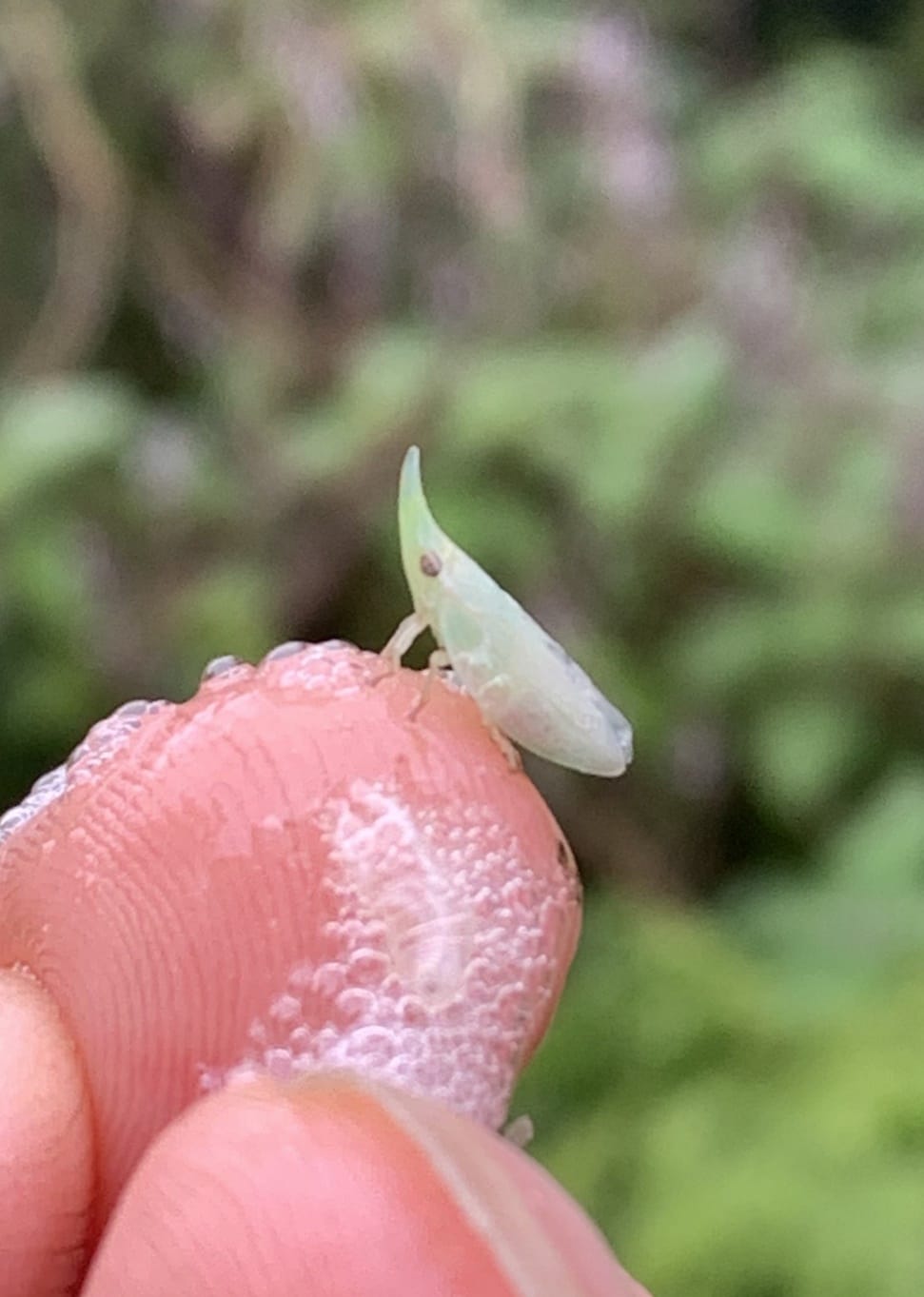
The biology of Philagra parva has not been studied in any detail, so I’m dependent on information about its relative in Europe, Philaenus spumarius. This European spittlebug has 16 different colour morphs, which have been subject to genetic studies trying to work out why. No such luck with ours, which doesn’t seem to vary.
The spit comes from the bug sticking its spiked mouth (remember that all bugs have spiked mouths) into the water-carrying tube of a plant (the xylem tube), not the sticky sap carrying phloem tube. It's a low-nutrient watery diet, so the bug has to suck large amounts – but it uses the high water flow to make the froth.
As the water is excreted at the tail end it is mixed with air and a self-produced foam-stabilising chemical so that the bubbles don’t instantly pop.
The froth makes a shelter from predators and from desiccation. All from having a poor diet.


